Record and replay groups of keyboard and mouse actions With the built-in action wizard editor.
|
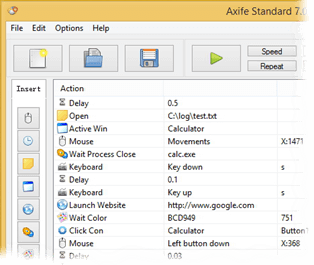 |
Record and replay groups of keyboard and mouse actions With the built-in action wizard editor.
|
|
Another example: determining whether the roots of a polynomial generate a Galois extension. The solution would involve verifying the normality and separability. For instance, if the polynomial is irreducible and the splitting field is over Q, then it's Galois because Q has characteristic zero, so separable.
Now, about the solutions. The solutions chapter would walk through these problems step by step. For example, a problem might ask for the Galois group of a degree 4 polynomial. The solution would first determine if the polynomial is irreducible, then find its splitting field, determine the possible automorphisms, and identify the group structure. Another problem could involve applying the Fundamental Theorem to find the correspondence between subfields and subgroups.
Wait, but what about the exercises? How are the solutions structured? Let me think of a typical problem. For example, proving something about the Galois group of a specific polynomial. Like, if the polynomial is x^3 - 2, the splitting field would be Q(2^{1/3}, ω) where ω is a cube root of unity. The Galois group here is S3 because the permutations of the roots. Dummit And Foote Solutions Chapter 14
In summary, the solutions chapter is essential for working through these abstract concepts with concrete examples and step-by-step methods. It helps bridge the gap between theory and application. Students might also benefit from understanding the historical context, like how Galois linked field extensions and groups, which is a powerful abstraction in algebra.
Now, the user is asking about solutions to this chapter. So maybe they want an overview of what the chapter covers, key theorems, and perhaps some insights into the solutions. They might be a student struggling with the chapter, trying to find help or a summary. Another example: determining whether the roots of a
Wait, but what if a problem is more abstract? Like, proving that a certain field extension is Galois if and only if it's normal and separable. The solution would need to handle both directions. Similarly, exercises on the fixed field theorem: the fixed field of a finite group of automorphisms is a Galois extension with Galois group equal to the automorphism group.
Field extensions: Maybe start with finite and algebraic extensions. Then automorphisms of fields, leading to the definition of a Galois extension. Splitting fields are important because they are the smallest fields containing all roots of a polynomial. Separability comes into play here because in finite fields, every irreducible polynomial splits into distinct roots. Then the Fundamental Theorem connects intermediate fields and normal subgroups or subgroups. Now, about the solutions
How is the chapter structured? It starts with the basics: automorphisms, fixed fields. Then moves into field extensions and their classifications (normal, separable). Introduces splitting fields and Galois extensions. Then the Fundamental Theorem. Later parts discuss solvability by radicals and the Abel-Ruffini theorem.