

In the quiet that bookends those years, Robyn learned to name what happened without letting it be the only thing she was. The seizure had been a violent punctuation, not the paragraph. She kept dancing—more carefully, more consciously—because feeling herself was not only the music: it was the slow assembling of a life that could hold a body, a brain, and the occasional, fierce interruption between them.
Her hand flew to her throat. The railing became a spindle—too hard, too real. Someone bumped her; laughter collided against her ear. She tried to call out, to say something ordinary: I’m fine. The words snagged. Her vision peeled into strips of color. The adrenaline that usually electrified her body during a chorus folded inward and stilled. Her left arm went numb first, then a coldness like ice water traced down to her fingertips. Faces around her stretched like reflections on warped glass. A woman with pink hair leaned in, asking if she was okay. Robyn could hear syllables like distant bells but not their meaning.
Her knees folded against the rail; someone steadied her by the elbow. The support was warm. She tried to articulate: seizure? The word thunked somewhere unconnected to the language centers. A sharp metallic taste flooded her mouth. For a moment the world was a moving painting—no edges, no names—then came a sudden flare of light behind her left eye, and the room tipped. ifeelmyself robyn seizure
The chronicle doesn’t end with a diagnosis word on a chart. It evolves into rhythm: clinic visits, scans that show nothing, or an MRI that points to a small focus; medication trials that blur energy and bring their own math of pros and cons; the rare, wincing triumph of a night out that ends without incident. It becomes community—online groups that exchange tips on medication timing, friends who know to hold a wrist and keep watch, the small, practical rituals that steer risk down.
Paramedics arrived later—an ambulance light a floral incision through the night—and took her to a hospital that smelled like antiseptic and lemon. Time at the emergency department is elastic: jars of waiting, fluorescent lights scanning faces. Tests were run—blood work, CT, an EEG that felt like tiny sparrows pressed against her scalp. A nurse explained things in efficient syllables. The word “provoked” fluttered by—fever, lack of sleep, illicit substances—none of which fit neatly into her night’s narrative. The doctor considered many possibilities, spoke of focal onset and generalized patterns, and used words that suggested both explanation and uncertainty. In the quiet that bookends those years, Robyn
The seizure’s physicality was loud in ways sound could not catch: the tremor in her jaw, the involuntary arch of her spine, the way breath left the body in knocks rather than a tide. Inside, the clock of her thoughts ran on warped batteries. One precise, awful clarity pierced through the fog: Do not swallow your tongue—an old fear, anatomically incorrect but real in its terror. She could not move her tongue to reassure herself. She tasted copper. Her mouth drained of saliva until her lips were papery.
Then the episode broke—suddenness as merciless as its onset. The world rushed back like water filling a hollow. She collapsed onto a shoulder. The music, still playing, felt obscene in its normalcy. Sweat ran from her temples in cold lines. The person supporting her murmured a name she recognized: Mara. Robyn found her voice small and raw. “I—” she began. Words came out as fragile threads. “I think—seizure,” she managed. Her speech was slow, as if passing through sand. Her hand flew to her throat
When the seizure unfolded fully, it was not cinematic. It was private and ruthless. Time narrowed into jerks and stretches. She felt a furnace behind her eyes, a pulsing she could not command. Her left hand twitched, then both hands, a marionette shaking off its strings. The railing scraped across her palm like a warning. Around her, shouts turned into instructions she could not parse. Someone pressed a cool forehead against her neck; the contact grounded her like a tide pull.


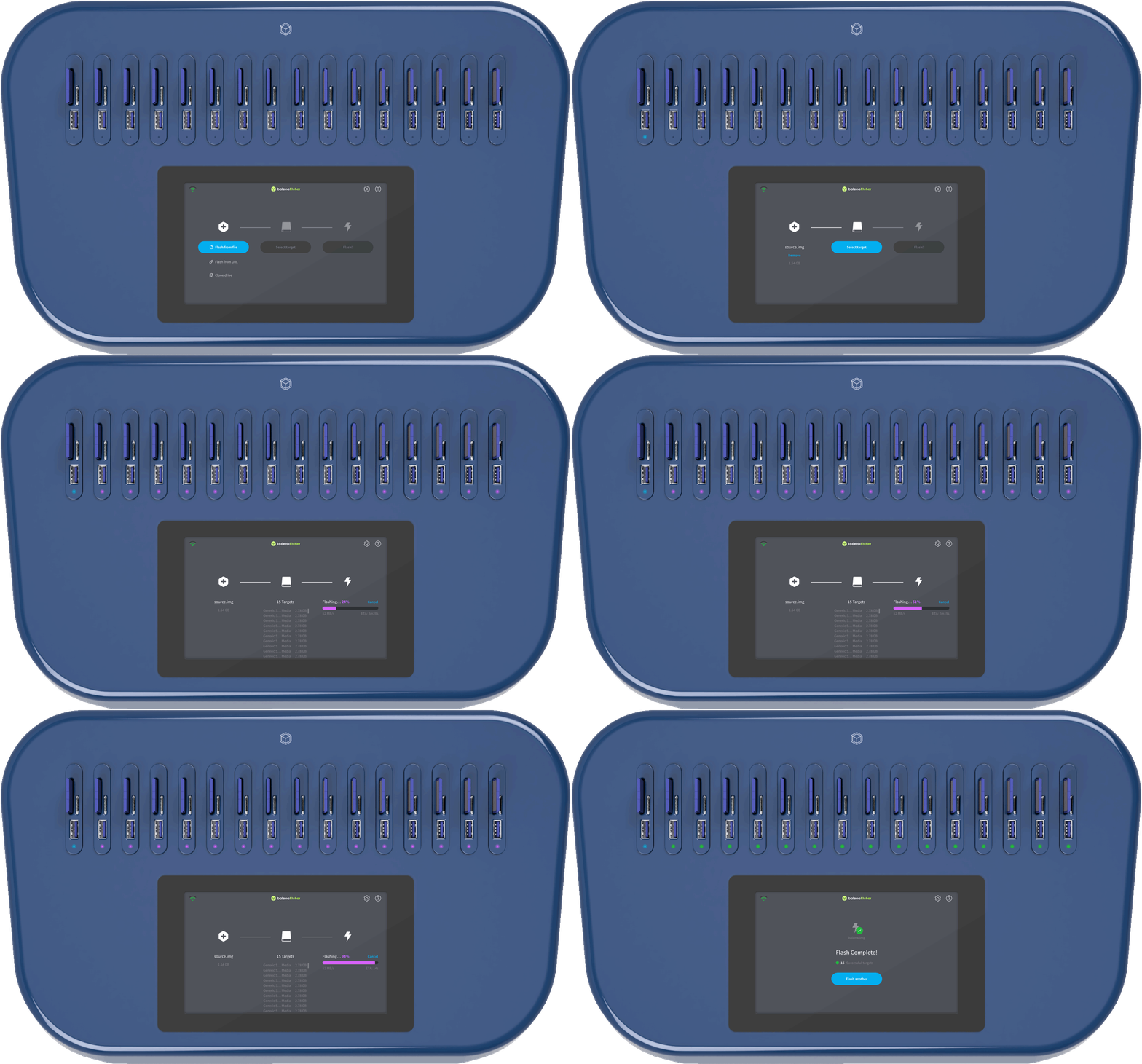
Every EtcherPro can flash up to 16 drives at a time if you are flashing from an online source. If you are flashing from a physical drive, you would be flashing up to 15 drives at a time, as the first slot would serve as the source. In the daisy-chaining scenario, you would only require one slot to serve as a source to flash the entire stack, when flashing from a physical drive.
EtcherPro offers USB (type A), SD and microSD interfaces by default, so you can flash up to 16 different drives / devices simultaneously. For instance, you can flash a balenaFin, a USB drive, an SD card and a microSD at the same time, as long as there is only one target per slot, and the source being flashed is the same for all target types.
EtcherPro supports USB (type A), SD and microSD interfaces, and can also flash single-board computers that are capable of being flashed via USB, as long as they are supported by Etcher. You can flash compute modules through carrier boards, for instance, flashing a Raspberry Pi CM3 through a balenaFin.
EtcherPro runs our open-source data-flashing software, Etcher, which can flash any kind of data. If you want to make sure that Etcher is capable of flashing your drive / device, you can download the latest version of Etcher and test it on your system to ensure compatibility.
When writing 16 drives simultaneously, EtcherPro can write up to 52 MB/s per drive, while when writing just 1 drive, EtcherPro can reach up to 200MB/s, so long as the drive / device can support those flashing speeds.
Etcher has a feature known as ‘trimming’ which can potentially accelerate the flashing of certain images by avoiding writing unused parts of ext partitions. As a result, you effectively get a bonus on the flashing speed.
EtcherPro flashes all target drives simultaneously, as such, the speed is determined by the drive that writes slowest. If you flash 1 drive that writes slowly, and 15 fast ones, the slow drive will determine the overall write speed. To account for this, make sure that all the drives, including the source drive (if any), can write at least as fast as EtcherPro flashes (52MB/s for 16 drives). Oftentimes, the advertised speed for a drive is the reading speed, rather than the writing speed (which is much slower). If you are sure your setup is up to spec and you still have issues please contact us.


.webp)